
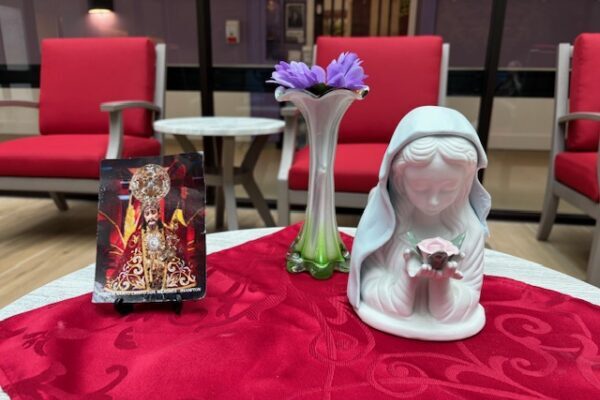
This is a story of the power of bringing in volunteers from specific cultural and faith backgrounds to ensure that this aspect of people’s unique identity is recognised and celebrated.
It’s 10:15am in the Goreway Resident Home Area, at Peel Manor in the Region of Peel, Ontario, Canada.
Zelia, a volunteer arrives and tells me she is leading a Portuguese Rosary Group which she does weekly. She tells me that her mother used to live in the home seven years previously, she lives across the street, and she likes to help now; “They often go back to the mother tongue, and it must be frustrating when no one understands them. Even if one person responds, it’s worth coming!”
Eight Portuguese people living in the home are helped to go into the light Atrium space of the home, where Zelia has set up a table with a red cloth, a cross and a picture of ‘Senhor Santo Cristo Dos Milagres’ which sets the scene.
The individuals in the group look much like many people living in care homes. They are sitting in wheelchairs, some are living with dementia and initially all seem quite quiet, sleepy and reserved. My colleague and I are invited to observe and wonder how this one volunteer will be able to reach and support all these people with a range of different needs.
Within moments, everyone is holding their Rosary beads and Zelia starts to recite the prayers in Portuguese.
It is as if a light goes on in the room. The familiarity of the words, shared during so many Sundays over so many years in their lives and the rhythm of the woman’s voice is like magic – waking everyone up in the room, and somehow restoring their status as individuals. Although they are in wheelchairs, it feels as if they are standing tall in the presence of their God. Gradually each person joins in with the prayers. There are moments when Zelia forget some of the words – she tells me that she is a bit rusty with knowing all the prayers. But this is like a gift to her group members as some of the older adults just step in and take a lead – they know the words well! They are proud to lead again! Religious songs follow and there are people with beautiful voices, whose sounds lift to the heights of the sky in the Atrium like angels.
I am not Portuguese. I am not a Catholic. I do not understand any of the words. However, I feel completely connected with this spiritual experience and it moves me deeply.
Once the Rosary is completed, Zelia invites some general chat in the group. The atmosphere is both animated and relaxed. She tells me that this part of the group is appreciated just as much as the formal side of the worship, much as many people enjoy the social element of the church. I do not know the content of the conversations, but it feels like the weather, politics and the general state of the world might be involved! She skilfully involves each person in the group. I no longer see the wheelchairs, the grey hair, the LTC ‘resident’. They are a group of friends, who enjoy sharing their language and their faith – and perhaps, even more importantly, feeling seen and heard again.
Consultant Trainer
MCM UK